
Why Salesforce Headless Is Gaining Attention
One of the topics that turned heads at the recent Salesforce event was Salesforce Headless. Today, customers interact with businesses through multiple platforms instead of relying on just one. A person may browse products on a website, continue exploring a mobile app, and later complete the purchase through another channel. Because of this behaviour, customers now expect digital experiences to feel smooth, connected, and personalised across all platforms.
For businesses, this shift has influenced how digital systems are being designed. Simply having a website is no longer enough. Many companies are now exploring more flexible solutions that can deliver fast and consistent experiences everywhere their customers interact.
Understanding the Concept of Headless Architecture
To understand Salesforce Headless, it is important to first understand the meaning of the term “headless.”
In traditional architecture, the front-end and back-end are directly connected. The front-end is the visual layer users interact with, while the back-end handles business logic, data management, automation, and system operations.
In a headless architecture, these two layers are decoupled.
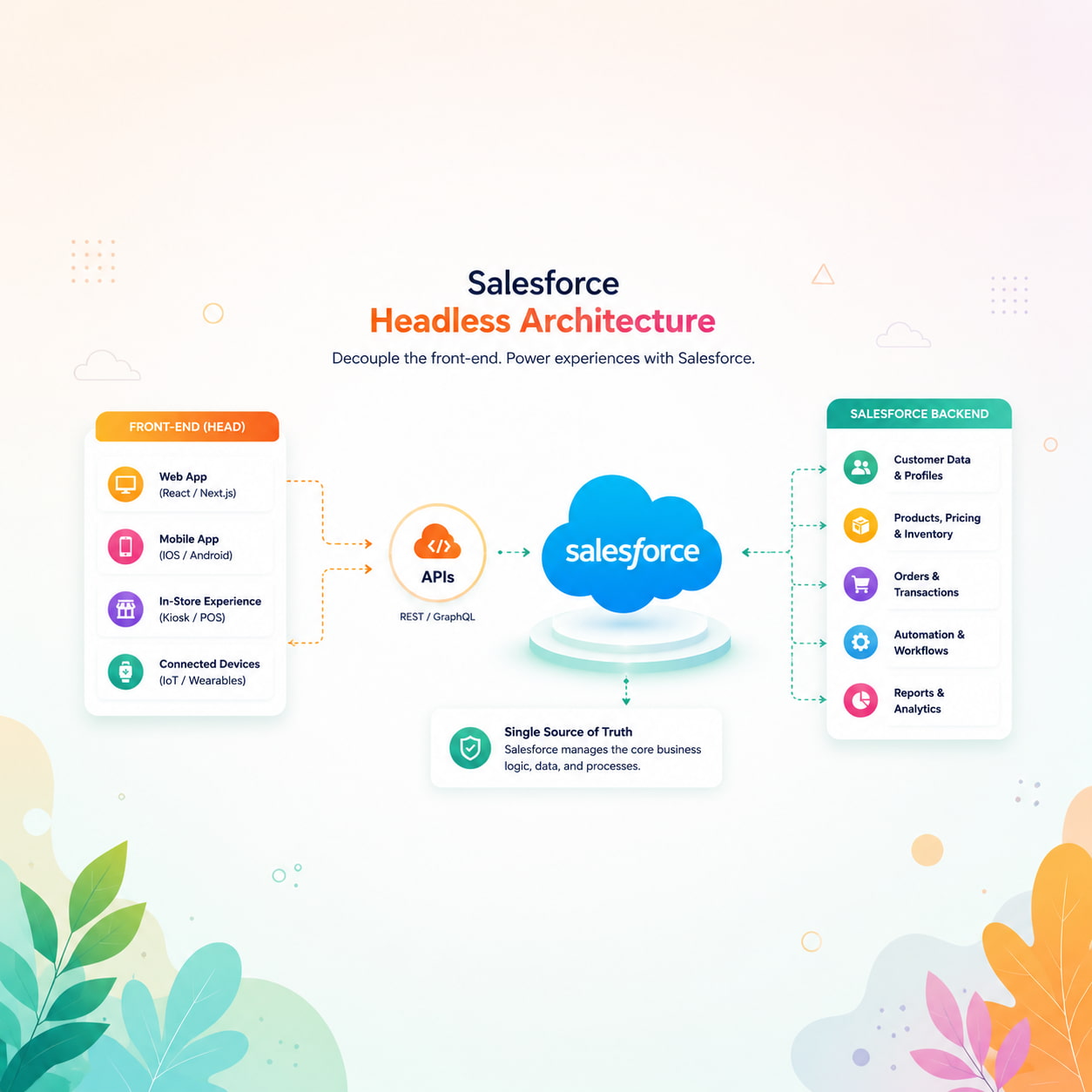
The “head” refers to the presentation layer or user interface, such as a website, mobile application, smart device, or any digital channel customers use to interact with a business. Salesforce serves as the back-end platform that manages customer data, products, integrations, workflows, and automation.
The connection between the front-end and Salesforce is established through APIs. This approach allows businesses to build more customized and flexible user experiences while continuing to use Salesforce as the central system for data management and business operations.
How Salesforce Headless Architecture Works
In a Salesforce Headless setup, developers build custom front-end using technologies like React, Angular, Vue.js or mobile development frameworks.
Whenever the front-end needs information, it sends a request to Salesforce through APIs. Salesforce processes the request and returns the relevant data.
For example:
- A customer visits an online shopping website
- The website requests product details from Salesforce
- Salesforce sends the information through APIs
- The front-end displays the products to the customer
Although the interface is customized, all core business functions such as inventory management, pricing, order processing, customer records, and automation continue to operate inside Salesforce.
This setup can enable companies to create modern digital experiences while maintaining a structured backend system.
Learning About Salesforce Headless
When I first started exploring Salesforce Headless, the concept initially felt difficult to understand.
I had always imagined systems where the front-end and back-end worked together as one connected structure, so the idea of separating them felt unusual at first. However, after spending more time learning about the architecture, I began to understand why this approach is gaining attention in modern digital experience discussions.
One of the most interesting aspects was the level of flexibility the architecture can potentially provide.
Salesforce can continue handling backend operations such as workflows, automation, customer data, and business processes, while developers have the freedom to build completely customized front-end experiences. This opens up possibilities for businesses to design websites, mobile applications, or other digital interfaces without being tightly restricted by traditional front-end structures.
What I found particularly interesting was the idea of Salesforce acting as the central system behind the scenes, while different front-end experiences interact with it through APIs.
Exploring Headless architecture also changed the way I think about modern application design. Instead of building experiences around platform limitations, businesses can potentially design systems that better match their customer expectations and digital goals.
Although concepts like APIs, integrations, and custom front-end development can initially feel technical, learning about them also makes the topic exciting because they open the door to more flexible and scalable digital experiences.
Overall, exploring Salesforce Headless gave me a better understanding of how modern digital architectures are evolving and why flexibility is becoming increasingly important in customer experience design.
A Possible Use Case for Salesforce Headless
Imagine a fashion retail company that wants to provide customers with a seamless shopping experience across different platforms.
Instead of using a standard e-commerce template, the company could create:
- A custom website built using React
- A dedicated mobile shopping application
- Interactive digital screens inside physical stores
All these platforms would connect to Salesforce through APIs.
Customer information, product details, pricing, and order management could be managed centrally through Salesforce, while each platform delivers its own tailored experience.
As a result, customers could receive a consistent experience whether they shop online, through an app, or inside a physical store.
Potential Challenges of Salesforce Headless
Although Salesforce Headless provides many advantages, there are also certain challenges involved.
Increased Development Complexity
Since businesses need to build their own front-end systems, development becomes more technical and
requires experienced developers.
Higher Initial Investment
Custom-built solutions may require more time, effort, and cost compared to traditional, ready-made
templates.
Dependency on APIs
A headless architecture depends heavily on APIs, making API performance, security and maintenance
extremely important.
Despite these challenges, the approach remains appealing for its potential to deliver long-term flexibility and scalability.
The Growing Interest Around Salesforce Headless
The future of digital experiences is gradually moving towards greater flexibility, speed, and personalisation.
Today’s customers expect businesses to deliver smooth experiences across websites, mobile apps, social media platforms, and even smart devices. To meet these expectations, companies need systems that allow them to innovate quickly without being limited by traditional architecture.
Salesforce Headless appears to support this shift by combining Salesforce’s powerful backend capabilities with modern front-end technologies.
As digital experiences continue to evolve, Headless architecture may become an increasingly important approach for businesses looking to build flexible and connected customer experiences.
Conclusion
Salesforce Headless introduces a new way for businesses to think about digital experiences. By separating the front-end from the back end, companies can gain more flexibility, faster innovation, improved performance, and stronger omnichannel capabilities.
Although implementing a headless architecture requires technical knowledge and proper planning, it may offer long-term benefits for future-focused businesses.
In a world where customer experience has become one of the biggest factors behind business success, Salesforce Headless offers an interesting approach to building modern and connected digital experiences.